Three people are working on the same equation in a Telegram group. Two get different answers. Someone posts an AI-generated solution, but the screenshot leaves out the original prompt. Nobody can tell whether the model saw the same problem.
Now imagine the mentor is already in the chat. The group can give it the exact equation, compare both solutions and ask which step caused the disagreement. The next question belongs to whoever spots something worth challenging.
A disclosure before anything else, because this is a field note about a bot that is not the one this site sells. Tavi is ours: the workshop behind @talaforge_bot also runs a study bot — @tavi_assistant_bot, at t.me/tavi_assistant_bot. Nobody writes a neutral review of their own bot, so this is not one. What we can do instead is publish a real transcript in full — the student's attempt, the step that was actually wrong, the correction — and say plainly what that does and does not prove.
Tavi is a study mentor rather than a calculator with a chat window. It works through whatever a student brings — maths, physics, chemistry, any subject where a solution is made of steps and any step can be the wrong one — and it can be added to group chats. The worked example further down is maths, because maths is what our transcript happens to show. What transfers between subjects is not the example. It is the method.
From AI astrology to a mentor with a specific job
India offers a revealing example of how people give AI a role before they ask it a question.
In April 2026, The Times of India reported findings from an iMeUsWe pilot study describing AI-based astrology consultations, in which questions about relationships and marriage dominated the platform's reported activity. In late August, Associated Press reported on people seeking spiritual guidance through chatbots. Both samples describe particular services rather than national AI adoption, and astrology and spiritual teaching are distinct practices — but both show AI presented through a recognizable advisory role.
Our interpretation is that the role helps define the conversation. A person approaching an AI astrologer brings different expectations from someone approaching a study mentor. The latter needs a place to say, “I understand the formula, but I cannot see why it applies here.” For Tavi, that role is made concrete through the instructions you give it: inspect my attempt, explain the assumption, ask me a question and let me try again. When friends join the conversation, they can challenge the explanation too.
Why the Telegram group chat is a timely place to try it
The discussion about AI in education is moving quickly. In an analysis republished on September 8, 2026, researcher Thomas Corbin examined what students might gain and lose as universities introduce AI teaching tools. He argued that the value of an educational interaction extends beyond the information in an answer. That question matters in an informal study group too: what are people still doing with each other (Corbin's analysis in The Conversation, republished by Phys.org)?
Telegram has meanwhile expanded what bot developers can build. Its May 7 update introduced Guest Bots, which can respond when mentioned in a conversation, with access limited to the tagged message and its replies. The June 11 release added rich text for bots — formulas, superscript, subscript, tables — which is why working shown in a chat can now be read rather than decoded; on August 25 came buttons inside messages.
Those releases describe what developers can build, not what any one bot has adopted. Tavi's group integration is the capability at stake here; support for newer features such as Guest Mode and inline quiz buttons depends on the individual bot.
The practical opportunity is a shared place for the problem, the explanation and the questions it produces. A group can examine the same working without passing around disconnected screenshots.
What a group adds to an AI tutoring conversation
An AI tutor can give one person a useful explanation. A group introduces several perspectives on whether that explanation actually makes sense.
One learner may understand how to manipulate an equation but overlook its domain. Another may spot the restriction and struggle with the algebra. A third may need a numerical example first. Their questions expose different parts of the same problem — and if someone forgets an assumption, another member can add it before the answer becomes the basis for everyone's working.
There is a real design challenge here. In a March 2026 study, 102 teachers in training worked in 21 groups with ChatGPT as a feedback contributor. Researchers observed useful contributions and efficiency gains, alongside reduced peer-to-peer idea-building in some groups. The study covered a single session of lesson-design work; it does not establish long-term outcomes for Telegram study groups (Agostini and colleagues in Frontiers in Education).
The practical takeaway is to give people a task before requesting the AI's explanation. Ask everyone to attempt the problem, nominate the disputed step and say what evidence would resolve it. The bot then has a specific contribution to make to a discussion already under way.
Worked example, maths: a root that does not belong
Solve √(2x + 3) = x − 3 over the real numbers. It is a useful test of an AI maths explanation because the algebra produces two candidates and only one satisfies the original equation. The example below is worked independently for this article; it is not a recorded Tavi response.
Squaring both sides gives 2x + 3 = (x − 3)². Expanding and rearranging: x² − 8x + 6 = 0. The quadratic formula produces x = 4 ± √10. Both values solve that quadratic, and a solution that stops here has left an important check unfinished.
This is the moment to bring the mentor into the discussion:
We are solving √(2x + 3) = x − 3 over the real numbers. Squaring gives x = 4 ± √10. Our group disagrees about whether both answers work. Ask us one question that helps resolve the disagreement before giving the solution.
That prompt carries the complete equation, the domain, the group's working and the point of disagreement — and it leaves people room to respond.
The expression under the square root requires x ≥ −3/2. But the left side of the original equation is also nonnegative, so the right side must be nonnegative too: x − 3 ≥ 0, and therefore x ≥ 3. The candidate 4 − √10 ≈ 0.838 fails that condition. Squaring allowed a positive number and its negative to become equal, so solving the squared equation alone introduced an extra candidate. The remaining value is x = 4 + √10, and an exact check confirms it: 2x + 3 = 11 + 2√10 = (1 + √10)², so √(2x + 3) = 1 + √10 = x − 3.
Then give each person something to explain. One member says why the square root requires a domain restriction, another why x ≥ 3 is necessary, a third verifies the surviving root directly in the original equation. If an explanation is unclear, challenge the exact step: you listed two roots of the quadratic — check each one in the original square-root equation, and explain why a root of the quadratic might fail it. Agreement from an AI does not settle the mathematics; the original equation provides the test.
The same method in physics and chemistry
None of that was really about maths. It was about naming the step where the reasoning is allowed to fail — and maths is simply the subject where that step is easiest to write into a chat message.
In physics the candidate that does not belong usually gives itself away through units: an answer in metres where the algebra produced metres per second, or a sign that came from choosing a direction and then forgetting the choice. Ask the mentor to check the dimensions before it checks the arithmetic and a whole class of confidently wrong answers falls away.
In chemistry it is usually the ratio. A balanced equation is a statement about moles, not about grams, so a solution that converts to grams too early looks reasonable on every line and is wrong at the end. Ask which quantity the ratio applies to before asking for the number.
The request is the same one every time: name the assumption, ask us a question, and check the final answer against the original condition. That is what carries across subjects, and it is what a group can hold the bot to.
Instructions that make room for disagreement
Calling a bot a mentor becomes useful when it changes the conversation you ask for. Try this at the start of a session:
Help our group understand the problem below. First ask us for our attempts. When we disagree, identify the mathematical step that needs checking. Start with one hint and wait for our reply. Define unfamiliar symbols when asked. If information is missing, ask for it. Explain corrections directly and check the final answer against the original problem.
That is a prompt to try, not a claim that Tavi ships a dedicated teaching mode with those behaviours guaranteed.
A useful mentor voice is patient about confusion and direct about an error. “That step assumes the denominator is nonzero” tells the group what to examine; general encouragement leaves the reasoning untouched. If people need different levels of detail, ask for two explanations of the same step and keep the underlying claim identical, so the two can be checked against each other.
A real transcript, mistake included
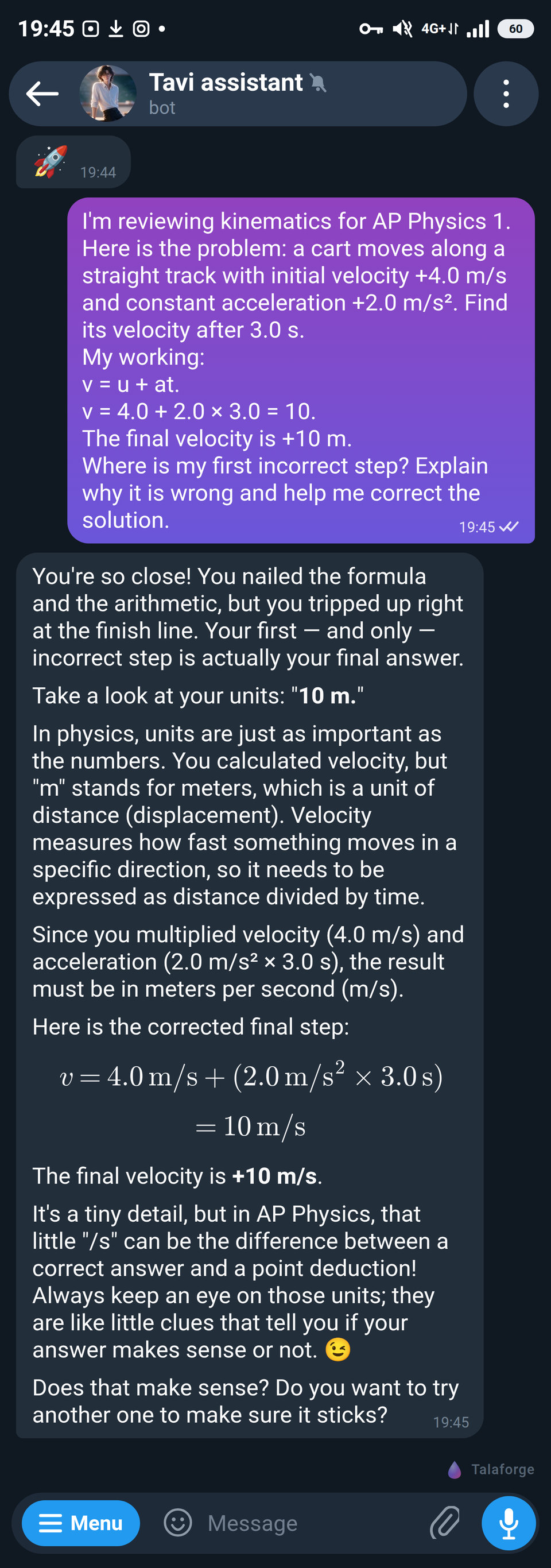
The picture at the top of this article is one real conversation with Tavi, and it is short enough to read in full. A student revising kinematics for AP Physics 1 sent the problem — a cart on a straight track, initial velocity +4.0 m/s, constant acceleration +2.0 m/s², find its velocity after 3.0 s — along with their own working, and asked one specific thing: where is my first incorrect step, and why is it wrong?
The working looks finished. v = u + at, then 4.0 + 2.0 × 3.0 = 10, then “the final velocity is +10 m”. The formula is right and the arithmetic is right, which is exactly why this mistake survives a reread: it is in the unit, not in the number. Tavi says so in as many words — the first and only incorrect step is the final answer — then explains why “m” is a distance while velocity has to be a distance divided by a time, and rewrites the last line with the units carried through: v = 4.0 m/s + (2.0 m/s² × 3.0 s) = 10 m/s.
Two things there are worth more than the correction itself. It names the step instead of re-solving the problem from the top, so every line that was already right still belongs to the student. And it ends by handing the work back — “does that make sense? do you want to try another one to make sure it sticks?” — which is the difference between a mentor and a solver.
That is one conversation, and it means exactly what it shows: a problem being worked through, the first wrong step named, a question coming back. It is not a claim of exam-specific support, it is not the boundary of what Tavi will discuss, and no assessment a bot gives is an official mark.
The mistake in that transcript is the student's, which is the ordinary case: most of the time the wrong step belongs to the person asking, and what they need is for it to be named rather than smoothed over. A group that cannot catch a wrong step is not made safer by a confident assistant. It is made less safe.
Exam practice, and what a mark is not
Tavi works through exam problems, which makes preparation one practical use of the mentor — and the habits it drills (check the domain, check the units, check the answer against the original condition) are useful well beyond any one exam or any one subject.
For a real session, give the full task and your own attempt, and ask it to find the first invalid step and explain what makes it invalid. Use official materials for your exam year when you need the task format and the marking criteria: generated practice helps you revisit an idea, and an AI's assessment of a solution is not a mark.
Some disagreements are not about the calculation at all. Ask for the average speed of a journey with one half at 60 km/h and the other at 90 km/h and the answer depends on what “half” means: 75 km/h for equal times, 72 km/h for equal distances. Ask about “a solution of salt” without saying how much salt and the same thing happens. The useful request names what is missing before the arithmetic starts — and in a group, that is usually the argument worth having.
The ten-minute test
Ten minutes, three people, one problem whose answer you can verify independently.
- Open t.me/tavi_assistant_bot and add it to a small group.
- Everyone solves √(3x + 4) = x − 2 alone first and writes the answer down without discussing it.
- Send the mentor one self-contained message: the equation, the domain, both answers, and the instruction to ask a question before giving the solution.
- Whoever was wrong explains why — in their own words, not the bot's.
- Take a second problem and do it without the bot. For checking: the necessary condition is x ≥ 2, squaring yields x(x − 7) = 0, and only x = 7 satisfies the original equation.
How much the bot sees in a group is decided by Telegram's permissions, not by the bot. With ordinary privacy mode enabled, commands and replies reach it; broader access works differently, and a bot being quiet does not by itself tell you which messages it receives — Telegram's own bot FAQ is the authority. If what you want is a character of your own rather than a study bot, giving a character its own Telegram bot is a separate job.
Bring Tavi a problem your group disagrees about — @tavi_assistant_bot. Include both attempts. Ask for the step that would resolve the disagreement, and let someone in the group make the next move.